More Amtrak equipment, California tunnels, Corridor ID on the list The movement to develop a great train network in the United States made undeniable gains in 2025: Illinois passed transit legislation worth $1.5 billion a year, which not only will continue to fund...
Caltrain Shows Why Every Region Should Be Moving Toward Regional Rail
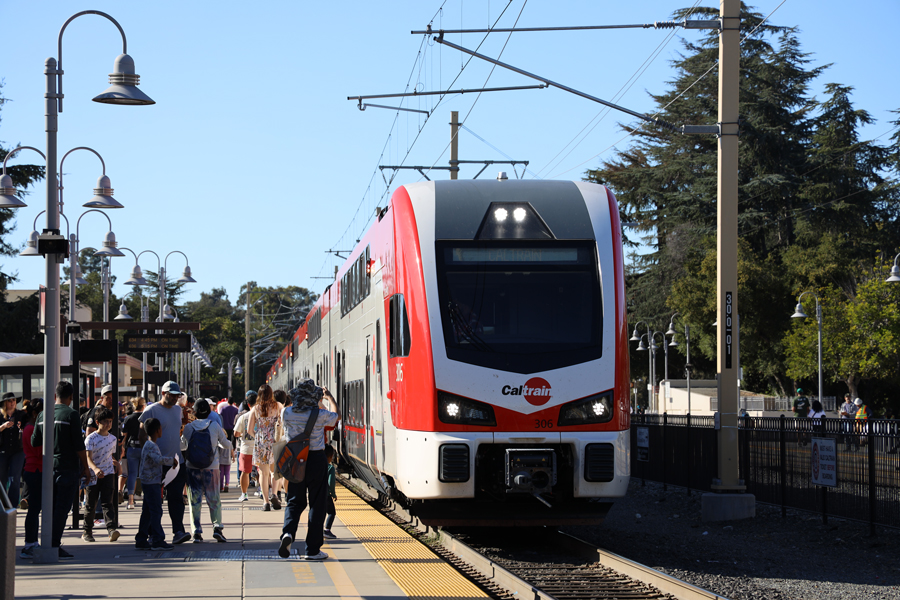
Faster speed, increased frequency, and more reliable service are causing ridership growth on Caltrain, the San Francisco Bay Area’s passenger railway. The ridership increase and service upgrades are a direct result of the electrification of Caltrain’s entire fleet of rolling stock in September 2024. “For the first time in the railroad’s 160-year history, diesel service was replaced with electric service along the 50-mile main line between San Francisco and San Jose,” Caltrain reported.
Caltrain’s total ridership in Fiscal Year 2025 (ending June 30, 2025) increased 47% over the previous fiscal year, from 6.2 million to 9.1 million passengers. In June 2025, Caltrain recorded more than 1 million monthly passengers for the first time since the pandemic. It passed the 1 million-passenger mark in July and August as well, which was roughly a 60% increase over ridership totals for those months in 2024, just before the fleet’s electrification.
The results are a powerful argument for electrification and the adoption of a regional rail model of service by every commuter railway in North America — i.e., offering fast, frequent service throughout the day, including weekends, instead of catering to antiquated commuting patterns and weekday rush hours.
In December, the American Public Transportation Association recognized Caltrain as the fastest growing transit agency in the U.S. Caltrain’s executive director said that the system “has been reinvented” and that California is “seeing the benefits every day with growing ridership, cleaner air, quieter trains, and less-congested roads.”
Get Involved
Tell Congress: It’s time to reconnect the country with high-speed and regional rail!
The nuts and bolts of reinvention
The electric trains’ superior acceleration and deceleration—and reliability—allow Caltrain’s new schedule to offer 20% more service on weekdays, faster travel times, and “predictable ‘clock-face’ departures and 30-minute off-peak frequencies.” (See the Alliance’s recent essay on the critical importance of frequency.) The new trainsets also have more seating capacity than the old diesel trains: they’re seven-car sets versus five-car sets.
Electrified express trains now travel from San Francisco to San Jose in an hour, and the trip takes about 75 minutes on local trains, versus nearly two hours on the old diesel trains. One train in each direction stops at every station at least every half-hour. Trains stop at 16 stations every 20 minutes and 11 stations every 15 minutes.
These upgrades are also generating a sharp rise in customer satisfaction. In a 2025 survey, riders gave Caltrain a 4.41 (of 5) rating, up from 4.02 in 2024. It was Caltrain’s highest rating in 27 years of survey taking.
In addition to creating faster, more frequent, and more reliable service, the electrified trains return nearly a quarter of their energy to the grid through regenerative braking technology, which works by “driving an electric motor in reverse to recapture energy rather than losing it as heat during braking.”
Regional rail rising?
Electrification has allowed Caltrain to steadily adopt a regional-rail service model. Notably, it more than doubled the number of daily trains on weekends after electrification to 33 departures in each direction. As a result, weekend ridership has more than doubled. In fact, it now exceeds pre-pandemic level, even though Caltrain’s overall ridership in 2025 remained at about 60% of pre-pandemic levels.
And Caltrain’s commitment to regional rail could get a boost in this fall’s California elections.
Last October, Gov. Gavin Newsom signed a bill that authorizes a Bay Area transit funding ballot referendum. A signature-gathering campaign is underway to place it on the ballot in November.
If it does appear on the ballot and voters approve the measure, a new, regional transportation sales tax of 1% in San Francisco and 0.5% in surrounding counties will be levied. The tax will generate nearly $1 billion annually creating a stable, dedicated funding source for local transit systems.
Illinois is also moving toward the regional-rail model, as the Alliance reports here, with the passage of a transit law that invests $1.5 billion annually in trains and transit. It “isn’t a maintenance bill,” we write. Instead, “it positions Illinois to do something that few American states have attempted: build a modern, frequent, interconnected railway network that treats mobility as essential infrastructure rather than a social service.”
The challenge now is to keep building the momentum in states already on board—most notably California, Illinois, and New York—while making the case for regional rail as “essential infrastructure” for building stronger economies, healthier communities, and a cleaner environment across the U.S.
The Latest from HSRA
Our Latest Blog Posts
Check out the latest news, updates, and high speed rail insights from our blog!